

Good Customer Support Wins Back Customers, But is AI Delivering on That?
60% say good complaint handling can win them back. Only 35% welcome AI support. New RepTrak data on AI, customer service and reputation.
Reputation Intelligence for the Pharmaceutical Industry
Leverage data-driven insights to monitor, measure, and manage your reputation in the Pharmaceutical industry.
While innovation drives progress, public skepticism around drug pricing, transparency, and ethics can erode trust. Negative perceptions not only damage stakeholder relationships but also impact market value. In this high-stakes environment, maintaining your brand's reputation is essential to long-term success.
RepTrak equips Pharma companies with the tools necessary to navigate complex reputational challenges. With continuous insights into public sentiment, media impact, and regulatory perceptions, RepTrak empowers teams to make data-driven decisions. Our team of experts partner with clients to manage risks, enhance trust, and stay ahead in an evolving industry.

Recommendations from experts who understand the nuances of the Pharma industry across global markets.

Scientifically validated approach, fine-tuned for Pharma, providing insights you can act on with confidence.

Leverage millions of global data points from over 20 years and learn from leaders who’ve transformed their reputation.
Built for Data-Driven Communication Teams
Gain insights into the perceptions and expectations of patients, regulators, healthcare professionals, and other key stakeholders.
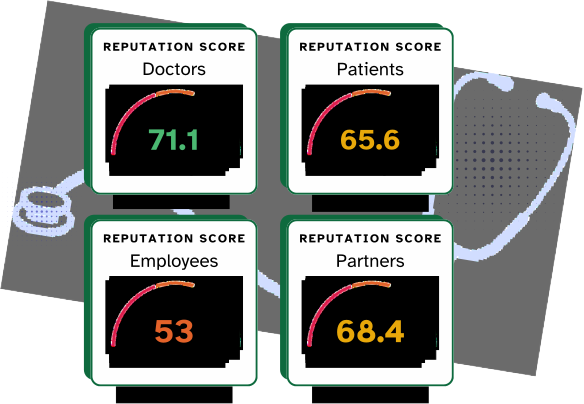
Global & Local Pharma Insights
The 2024 Pharma Report offers a comprehensive view of the Pharmaceutical industry's reputation landscape, highlighting key trends and challenges across global markets. As public expectations continue to rise in the post-pandemic environment, Pharma companies are confronted with increased regulations, demands for quick innovations, and shaky relationships with critical stakeholders.
Fill out the form to learn more about what's driving the industry's reputation recovery — and where improvement is still needed.
Previous reports can be found here:
Fill out the form
Download the 2024 report here
STAY UPDATED
60% say good complaint handling can win them back. Only 35% welcome AI support. New RepTrak data on AI, customer service and reputation.
Reputation sits on many risk registers with no measure behind it. Benefit of the doubt gives your risk committee a leading indicator it can trend.
You can spot a surprise early; here's where to look
A favorability score is one blended number. These 10 metrics break reputation into trust, workplace, governance, risk, and business outcomes instead.
A new study shows stopping channel reporting at reach is costing Communications leaders influence and a seat at the executive table. Here's how to correct that.
Annual trust studies measure institutional trust, not how your company is perceived. 6 limitations, and what continuous measurement covers in between.
Nike left the S&P 100 this week. Our Global RepTrak 100 data shows a parallel story: a steady Reputation Score covering a decade of lost ground.
Picking a reputation intelligence vendor is a bigger decision than most RFPs treat it as. Five questions that separate published data from vague claims.
What your audience cares about moves, and a reputation program that only tracks performance has no way to see it.
How often you measure reputation decides which questions the data can answer.
60% say good complaint handling can win them back. Only 35% welcome AI support. New RepTrak data on AI, customer service and reputation.
Reputation sits on many risk registers with no measure behind it. Benefit of the doubt gives your risk committee a leading indicator it can trend.
You can spot a surprise early; here's where to look
A favorability score is one blended number. These 10 metrics break reputation into trust, workplace, governance, risk, and business outcomes instead.
A new study shows stopping channel reporting at reach is costing Communications leaders influence and a seat at the executive table. Here's how to correct that.
Annual trust studies measure institutional trust, not how your company is perceived. 6 limitations, and what continuous measurement covers in between.
Nike left the S&P 100 this week. Our Global RepTrak 100 data shows a parallel story: a steady Reputation Score covering a decade of lost ground.
Picking a reputation intelligence vendor is a bigger decision than most RFPs treat it as. Five questions that separate published data from vague claims.
What your audience cares about moves, and a reputation program that only tracks performance has no way to see it.
How often you measure reputation decides which questions the data can answer.


