


When You Have A Single Reputation Score, It’s Hiding A Lot
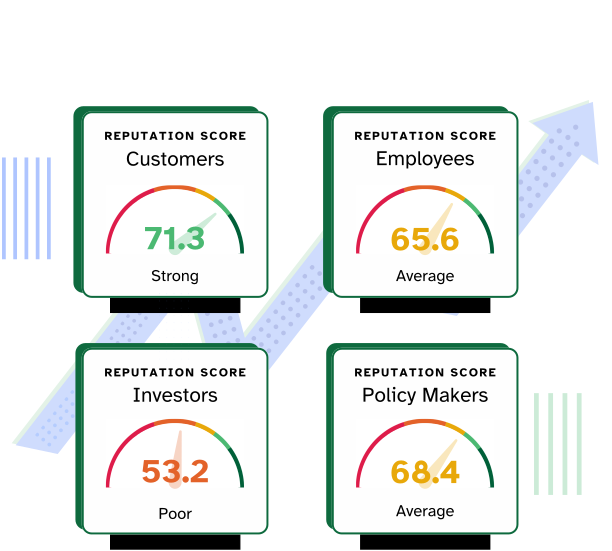
Many organizations believe they are managing stakeholders. What they are actually managing, in many cases, is averages.
Reputation Intelligence for the Financial Service Sector
Navigate the complexities of reputation management in financial services with tailored, data-driven insights designed to keep you ahead.
From insurance and investment firms to fintech innovators, financial institutions are facing declining trust alongside rising demands for transparency and innovation. As competition grows and customer expectations shift, keeping pace has never been more critical. With more consumers exploring alternative options, now is the time to take action.

RepTrak empowers finance leaders to maintain public confidence and stay ahead in a competitive landscape. With insights into reputation, trust, innovation, and ethical behavior, you’re equipped to turn perception into your strongest asset.

Recommendations from experts who understand the nuances of the Finance industry across global markets.

Scientifically validated approach, fine-tuned for Finance, providing insights you can act on with confidence.

Leverage millions of global data points and learn from leaders who’ve transformed their reputation.
Built for Data-Driven Communication Teams
Gain deep insights into the perceptions and expectations of your customers, regulators, and other key stakeholders.
As inflation surged in the pandemic era and economic pressures mounted, the reputation of Financial Services companies suffered the consequences. Yet following 2023's bank crash, the industry's reputation is recovering in 2024. RepTrak's 2024 Financial Services Report offers a comprehensive view of the industry's reputation landscape, highlighting key trends and challenges across global markets.
Fill out the form to learn more about what's driving the industry's reputation recovery — and where improvement is still needed.
Fill out the form
Download the 2024 report here
STAY UPDATED
Many organizations believe they are managing stakeholders. What they are actually managing, in many cases, is averages.
Against a backdrop of mixed public sentiment on AI, a number of companies are beginning to reframe their core product experiences around innately human elements. RepTrak data shows why this trend is likely to accelerate—and points to what you should be tracking.
The consumer health and pharma reputation landscape has shifted structurally since the COVID peak, and not in ways that more communications activity alone will fix. Here's what's facing new comms leaders in the space.
Most comms teams are watching the wrong things during viral moments (they're reacting to volume when they should be diagnosing Reputation driver exposure). We put together a framework for doing exactly that — using RepTrak Compass to move from reactive narrative control to structured reputation diagnosis.
Most comms teams are watching the wrong things during viral moments (they're reacting to volume when they should be diagnosing Reputation driver exposure). We put together a framework for doing exactly that — using RepTrak Compass to move from reactive narrative control to structured reputation diagnosis.
Stakeholders are paying closer attention to leadership visibility than they have in years. 48% say the CEO is the most appropriate voice to communicate company vision.
RepTrak's latest Current Events data shows that between Q4 2024 and Q4 2025, trust increased across both groups, but influencers moved faster, especially in digital channels like online advertising, owned social media, and social media news.
When stakeholders navigate economic complexity—personal optimism, national pessimism—they seek validation from multiple sources. Your channel strategy needs to adjust accordingly.
AI tools have a trust problem—just not the one you think. Our latest data shows AI as a communications channel is nearly as trustworthy as traditional news. But it's far less desirable. And the reason for that is trust in AI as a technology.
Explore how reputation leaders can move from AI integration to advantage in 2026 — using AI to shape perception, build trust, and drive long-term value.
Many organizations believe they are managing stakeholders. What they are actually managing, in many cases, is averages.
Against a backdrop of mixed public sentiment on AI, a number of companies are beginning to reframe their core product experiences around innately human elements. RepTrak data shows why this trend is likely to accelerate—and points to what you should be tracking.
The consumer health and pharma reputation landscape has shifted structurally since the COVID peak, and not in ways that more communications activity alone will fix. Here's what's facing new comms leaders in the space.
Most comms teams are watching the wrong things during viral moments (they're reacting to volume when they should be diagnosing Reputation driver exposure). We put together a framework for doing exactly that — using RepTrak Compass to move from reactive narrative control to structured reputation diagnosis.
Most comms teams are watching the wrong things during viral moments (they're reacting to volume when they should be diagnosing Reputation driver exposure). We put together a framework for doing exactly that — using RepTrak Compass to move from reactive narrative control to structured reputation diagnosis.
Stakeholders are paying closer attention to leadership visibility than they have in years. 48% say the CEO is the most appropriate voice to communicate company vision.
RepTrak's latest Current Events data shows that between Q4 2024 and Q4 2025, trust increased across both groups, but influencers moved faster, especially in digital channels like online advertising, owned social media, and social media news.
When stakeholders navigate economic complexity—personal optimism, national pessimism—they seek validation from multiple sources. Your channel strategy needs to adjust accordingly.
AI tools have a trust problem—just not the one you think. Our latest data shows AI as a communications channel is nearly as trustworthy as traditional news. But it's far less desirable. And the reason for that is trust in AI as a technology.
Explore how reputation leaders can move from AI integration to advantage in 2026 — using AI to shape perception, build trust, and drive long-term value.


