


When You Have A Single Reputation Score, It’s Hiding A Lot
Many organizations believe they are managing stakeholders. What they are actually managing, in many cases, is averages.
Reputation Intelligence for the Automotive Industry
Build trust, accelerate innovation, and strengthen customer loyalty with reputation insights tailored to the Automotive industry.
Automotive brands face increasing scrutiny over product quality, sustainability efforts, and customer trust. A single misstep — whether in manufacturing or communication — can cause significant reputational damage, impacting customer loyalty and long-term brand health.

RepTrak delivers more than data — we provide actionable reputation intelligence and expert guidance tailored to the Automotive industry. Whether it’s product launches, sustainability initiatives, or building customer relationships, our platform and Advisory team give you the insights needed to build trust and lead with confidence.

Recommendations from experts who understand the nuances of the Automotive industry across global markets.

A scientifically validated approach, fine-tuned for Automotive, providing insights you can act on with confidence.

Leverage millions of global data points and learn from industry leaders who’ve transformed their reputation.
BUILT FOR DATA DRIVEN PR AND COMMUNICATIONS TEAMS
Understand key stakeholder perceptions — customers, regulators, investors — and take proactive steps to build stronger, lasting relationships.
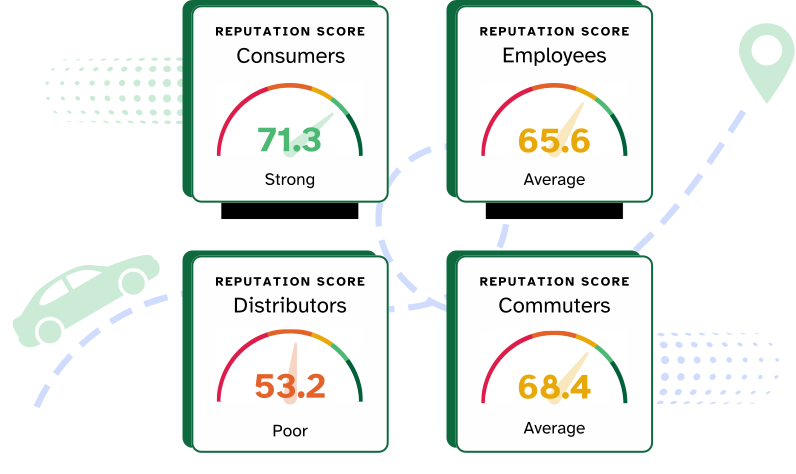
Across the transportation industry, reputation travels farther than any passenger. As these businesses face relentless pressure to deliver safety, sustainability, and seamless experiences, every journey becomes a test of trust that can build loyalty or erode it overnight.
RepTrak's Transportation Report reveals how stakeholders really feel about automotive companies today. Backed by data, it spotlights reputation wins in service reliability, safety, and sustainability and exposes gaps in citizenship, trust, and long-term resilience. Fill out the form to access insights that will help your company protect reputation, navigate disruptions, and strengthen stakeholder confidence in a high-stakes market.
Fill out the form
Download the report here
STAY UPDATED
Many organizations believe they are managing stakeholders. What they are actually managing, in many cases, is averages.
Against a backdrop of mixed public sentiment on AI, a number of companies are beginning to reframe their core product experiences around innately human elements. RepTrak data shows why this trend is likely to accelerate—and points to what you should be tracking.
The consumer health and pharma reputation landscape has shifted structurally since the COVID peak, and not in ways that more communications activity alone will fix. Here's what's facing new comms leaders in the space.
Most comms teams are watching the wrong things during viral moments (they're reacting to volume when they should be diagnosing Reputation driver exposure). We put together a framework for doing exactly that — using RepTrak Compass to move from reactive narrative control to structured reputation diagnosis.
Most comms teams are watching the wrong things during viral moments (they're reacting to volume when they should be diagnosing Reputation driver exposure). We put together a framework for doing exactly that — using RepTrak Compass to move from reactive narrative control to structured reputation diagnosis.
Stakeholders are paying closer attention to leadership visibility than they have in years. 48% say the CEO is the most appropriate voice to communicate company vision.
RepTrak's latest Current Events data shows that between Q4 2024 and Q4 2025, trust increased across both groups, but influencers moved faster, especially in digital channels like online advertising, owned social media, and social media news.
When stakeholders navigate economic complexity—personal optimism, national pessimism—they seek validation from multiple sources. Your channel strategy needs to adjust accordingly.
AI tools have a trust problem—just not the one you think. Our latest data shows AI as a communications channel is nearly as trustworthy as traditional news. But it's far less desirable. And the reason for that is trust in AI as a technology.
Explore how reputation leaders can move from AI integration to advantage in 2026 — using AI to shape perception, build trust, and drive long-term value.
Many organizations believe they are managing stakeholders. What they are actually managing, in many cases, is averages.
Against a backdrop of mixed public sentiment on AI, a number of companies are beginning to reframe their core product experiences around innately human elements. RepTrak data shows why this trend is likely to accelerate—and points to what you should be tracking.
The consumer health and pharma reputation landscape has shifted structurally since the COVID peak, and not in ways that more communications activity alone will fix. Here's what's facing new comms leaders in the space.
Most comms teams are watching the wrong things during viral moments (they're reacting to volume when they should be diagnosing Reputation driver exposure). We put together a framework for doing exactly that — using RepTrak Compass to move from reactive narrative control to structured reputation diagnosis.
Most comms teams are watching the wrong things during viral moments (they're reacting to volume when they should be diagnosing Reputation driver exposure). We put together a framework for doing exactly that — using RepTrak Compass to move from reactive narrative control to structured reputation diagnosis.
Stakeholders are paying closer attention to leadership visibility than they have in years. 48% say the CEO is the most appropriate voice to communicate company vision.
RepTrak's latest Current Events data shows that between Q4 2024 and Q4 2025, trust increased across both groups, but influencers moved faster, especially in digital channels like online advertising, owned social media, and social media news.
When stakeholders navigate economic complexity—personal optimism, national pessimism—they seek validation from multiple sources. Your channel strategy needs to adjust accordingly.
AI tools have a trust problem—just not the one you think. Our latest data shows AI as a communications channel is nearly as trustworthy as traditional news. But it's far less desirable. And the reason for that is trust in AI as a technology.
Explore how reputation leaders can move from AI integration to advantage in 2026 — using AI to shape perception, build trust, and drive long-term value.


